Tuesday, November 27, 2012

Links 11/27/2012

- India and China Deepen Economic Ties

- Saudi Arabia: King's Rumored Death and the New Line of Succession

- Intel Views Indonesia as a Lifeline - The West buys gadgets (until it runs out of money), but Asia is growing, no?
Desktop and laptop sales to millions of first-time computer buyers in Indonesia are likely to bolster revenue at Intel Corp. and offset some of the ground lost in more-mature markets where consumers are turning to tablets.

 The sales of desktops and laptops that use Intel's chips are expected to surge in Southeast Asia's largest economy as rising incomes enable more people to buy computers. Intel has been struggling in more-developed markets, where the most demand growth is coming from sales of smartphones and tablet computers that don't use Intel's processors.

Everyone is doing it, because this is a great way to be competitive. And everyone knows this:
- NOT JUST APPLE: Samsung Under Fire For Allegedly Giving Employees 16-Hour Workdays, One Day Off Per Month

-  UK: Increasing numbers of working people live in poverty, report finds. This is "great" (!), this means tha tmore and more people are becoming desperate-> They are becoming willing to work for less money ("they are becoming more competitive") -> The profits of the capitalists that will employ some of them (those that actually survive this ordeal) will be higher. Sacrifice an entire generation (the "lost generation" as they are already calling them), in order to gain cheap labor force for the future!

- TECH/Innovation: Harnessing Energy From the Body to Run Devices
Read more »
Read more »

Friday, November 23, 2012

Links 11/23/2012 + A story from Bulgaria:Welcome to your future dear PIIGS worker

  • Brent to eclipse US crude as world oil benchmark (livemint)
  • Iran doesn't like the dollar - in fact, Iran has been calling for an end to the current "petrodollar" system for years, and this is obviously the biggest reason why America has branded it as a "terrorist-state": Iran urges use of alternative currencies in global trade (PressTV)
  • Saudi Arabia Plans $109 Billion Boost for Solar Power (Bloomberg) - Why sell your oil now, when you can just save it for the future, when the "petrodollar" system is over and oil has been reprices MUCH higher in dollar terms (as the dollar is heading for hyperinflation and everyone who is everyone knows it)
  • What about all those alternative power sources? Well, they are not proving to be as efficient as we once hoped them to be, so, at least for now, we all "have to" pay the price by substituting winds and solar farms, as they cannot be profitable enough by themselves: Energy bills to rise by £170 a year to fund wind farms
  • China today confirmed the first successful carrier landings of its J-15 fighter aboard its first aircraft carrier the Liaoning (BusinessInsider)

And what about the West's demise? Here are some of the latest news:
  • After France, Britain's AAA credit rating returns to the spotlight (Telegraph)
  • There are still more than a million young people not in education, employment or training (Neet) in England, despite a dip in the numbers (BBC)
  • Greek Milk Costs More Than Anywhere Else In Europe As Suicide Rate Rises By 37% (ZeroHedge)

As a bonus, here is a very interesting article from Bulgaria: 40.000 Small Businesses in Bulgaria To Go Bankrupt by End-2012.
What does this article show us? Well, it shows us that the model that the ruling class are trying to enforce in the PIIGS countries, if not everywhere ( = improving the competitiveness of the workers by reducing their wages), will never bring back growth. Bulgarian workers are really cheap, but there are even cheaper workers in others countries, so, without any specialized training and education, these workers have a very hard time to find a job, and when they do, they get really low wages...Welcome to your future dear Western worker
Read more »
Read more »

Thursday, November 22, 2012

Links 11/22/2012


Read more »
Read more »

Wednesday, November 21, 2012

A few thoughts on the matter of deficits: Do they matter or what?


Family and financial problems have prevented me from updating this blog, and I also have to prepare from moving from Greece to Australia, so my free time is limited.

However, I just read a couple of articles that caught my eye, and I'd like to share a few quick thoughts on the matter of deficits:

Britain's official public deficit climbs higher

Public sector net borrowing soared to £8.6 billion ($A13.28 billion) last month, the Office for National Statistics said in a statement on Wednesday.
That compared with £5.9 billion ($A9.11 billion) in October 2011.
Market expectations had been for public borrowing of £6.0 billion in October, according to analysts polled by Dow Jones Newswires.
 
Everyone knows that almost all Western nations have been running trade deficits for decades know, and that it was once -famously- said that "deficits don't matter". This may sound strange, but I kind of agree: 

It's not the 'deficits/debts' themselves that matter, rather than the 'ability to repay these debts in the future through future productivity" that actually matters. For example, there are no people that would loan me 1.000.000$, because noone seriously believes that I will be able to produce enough wealth in the future to repay such a loan. But there are a lot of people that would gladly loan 1.000.000$ to APPLE, because they think (rightly or wrongly so) that APPLE will be able to produce enough wealth in the future to repay this loan (+ interest of course, why else would the bondholders loan the money?). 

The problem today is that most corporations (AND countries) have very little (or zero) CREDIBILITY (i.e noone believes that they will be able to repay their loans). 

This is why deficits didn't used to matter, but now they do: People used to think that "countries are always able to repay their loans", so they are always credible, and thus "their deficits don't matter [because they will be able to repay their debts in the future through future productivity]". Now, their credibility is gone, so now "deficits matter"...
--- 

Here's another interesting article, from the NY Times:

A Call for Japan to Take Bolder Monetary Action 

For years, proponents of aggressive monetary policy have offered this unusual piece of advice as a way to end Japan’s deflationary slump and invigorate the economy. Print lots of money, they said. Keep interest rates at zero. Convince the market that Japan will allow inflation for a while.
Japan’s central bankers long scoffed at such recklessness, which they feared would ignite runaway inflation. But now, the bank’s hand could be forced by an unlikely alliance of economists and lawmakers who have argued for Japan to take more monetary action after more than a decade of weak growth and depressed prices. 
Championing their cause is the former prime minister Shinzo Abe, who is favored to return to the top job after nationwide elections next month.
[...]
Japan’s monetary pump-priming is “like a morphine addiction that is getting worse,” Ryutaro Kono, chief economist for Japan at BNP Paribas, said Tuesday. “Fiscal or monetary policy doesn’t have the power to create new value” for Japan, he said.
Unfortunately, Japan is not the only Western nation that is doing this. It has been doing it for several years now, and it is probably reaching "the end of the road": More and more people are noticing that Japan, and most Western nations actually, are no longer producing a lot of products that the market actually wants and is willing to buy (i.e. "competitive products") [*].

So, what do these countries do? Well, they can't seem to be able to innovate their way out of the crisis by creating new, valuable products, so they start printing more and more money: This way, they decrease the wages of the workers, making them more competitive, and thy also use the newly-printed money to recapitalize the banks. Here's something from one of my previous posts:

1) Capitalism is based on the exploitation of the workers by the capitalists.

2) After the collapse of the former USSR, all the workers of the Soviet block + the Chinese workers were intergraded into the labor marker that truly became global.

3) Capitalists off-shored production to Asia, as the workers of those countries could be exploited much more so than the workers of the West (as the Western workers had achieved some important victories through a century of labor struggles, that inhibited the capitalists ability to exploit them).

4) As the industrial base of the West was diminishing, capitalism became more "leveraged" and credit-based, as it needed more and more "banking loans" to keep the system going:
-If a factory was closed down, either because the owner off-shored production to Asia or because it just couldn't compete against the cheaper goods that were made in China, the workers of that factory could still get a job, or start a business themselves, by getting a loan from the banks.
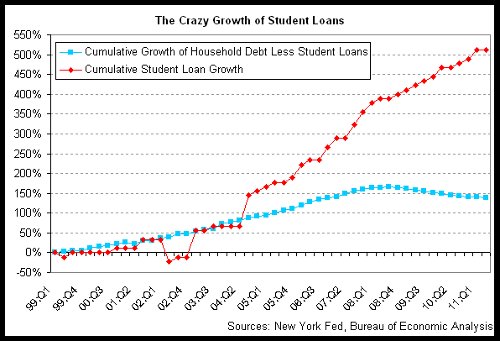
-The workers wages have stagnated for a long time (link), but they could still "afford" a new house, by getting a mortgage. And they could also afford rising tuition fees for their children's education, by getting a student loan. And they could even a new plasma TV set, by getting another "consumer's loan". And the list goes on and on.
-This meant that the construction workers could find a job (thanks to all these mortgages), and the companies that produce this plasma TV set and the merchants who sell this TV would make a profit. So, there would be a job for those who make these TV sets, or sell them.

5) The problem with all this is that the houses that the people live in are not "their" houses, they belong to the bank. And if you can't make your payment on your mortgage, then the bank kicks you out. Can all these debts be repaid? No, of course not.

6) So, the Western workers earn relatively low wages, and are deeply in debt, as they had to keep the system going by "overconsuming" for a very long time. And it's not just the workers, entire states are heavily indebted and cannot possibly repay their debts.

7) As the people cannot get any more loans, capitalism can't keep growing. No jobs for the construction workers, factories close down as noone can consume all the good that they produce, etc.

8) But as these debts cannot be repaid, the banks are also in trouble, as they have to write down heavy losses. This is a very heavy blow for them, as they are ALL bankrupt, just like Lehman Brothers.

9) The difference is that, unlike Lehman (and a lot of smaller banks), the rest of the banks were saves through endless bailouts. Let's not forget that the banks have become bigger than ever, as capitalism needed more and more credit. So, the bankers have the politicians in their pockets, and they managed to get the money they needed (from us). After all, they are "too big to fail", whereas we are not, we are "replaceable". So, all the wealth of our societies is being redirected to the banks, in order to cover their losses, leaving the rest of us to starve.

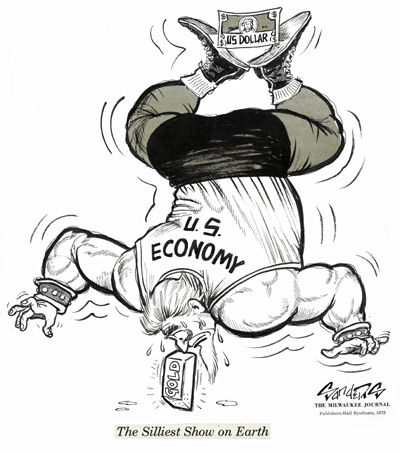
10) But the banks need a lot of dollars. Trillions and trillions of them. So, this "money" is being "created out of thin air" (quantitative easing - money printing). This process of money printing has being going on for many decades now, ever since Nixon abolished the gold standard. The system needed more credit, and so it became more leveraged. The gold standard was interfering with capitalism's need for increased leverage, so they abolished it. And now that the banks have to be bailed out, they are printing even more money than before - here's a great chart:


11) All this newly created "money" (currency) goes to the banks, so that they won't have to face another "Lehman-type" moment, or even a global collapse of the entire banking sector. But this newly created 'money' isn't based on newly created wealth (new products/services), nor on wealth's"monetary counterpart", gold (gold, as we have already explained, is the "monetary representation" of wealth, as capitalism has a tendency to monetize everything, and so all goods and services have a value that can now be expressed through gold, in order for the people to be able to exchange them in the market (buying/selling).

12)
As all this newly created "money" is not based on new wealth/gold, it is simply a way to debase the currency and redistribute wealth:
The banks get bailed out, by getting all the newly created "money", and the workers get paid less (as the value of the currency in which they are getting paid is being diminished). This is necessary for the capitalists, who get to save the banks, and improve the "competitiveness" of the working class. The destruction the currencies is a sacrifice that they have to make, in order to save the banking sector from collapsing, and at the same time to reduce the wages of the wokers, so that they become "more competitive", thus attracting capital investments.

13) One of the greatest "side-effects" of this process of "money printing" is that fewer and fewer people want to own/use the various currencies, as they can easily understand that these currencies will lose a lot of their current value in the future. More and more capitalists turn to gold for protection of their wealth, as they realize that gold is the one thing that will always remain constant. So, China, Russia, the oil states (and many other rich "players") are buying gold, and they are trying to dump the dollar when they trade with each other. The oil states have a "special role" to play in all this, because if and when they reject the dollar as a means of payment, the world will experience a great "oil crisis", much bigger than the 1973 oil crisis (which was the first time the oil states publickly rejected the dollar and demanded to be paid in gold, as they obviously didn't like America's decision to abolish the gold standard in order to print as many dollars as the USA wanted).


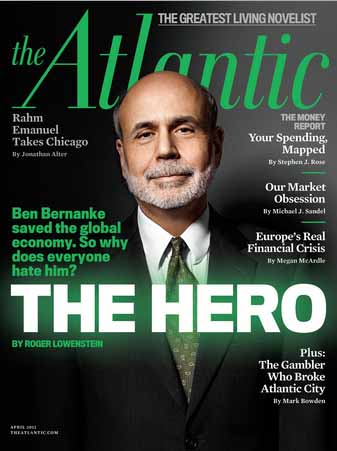
13) The West is obviously caught between a rock and a hard place. But saving the banks and impoverishing the workers are the top priorities, so this process of "money-printing" will continue, despite the various obstacles, twists and turns. Money printing is today a "systemic necessity" for capitalism, and there is not much point in putting the blame solely on Bernanke, Obama, Bush, the FED or their English/Japanese/European counterparts (The Europeans are also printing money, although Germany does not need the same amounts of "money-printing" as the rest of Europe, as the German workers are already very competitive, thanks to their high productivity. But Germany also accepts the need for money-printing, as it is the only way to save the banks from their "toxic loan situation". And they are VERY WELL PREPARED for the coming destruction of the dollar (hyperinflation), as the euro-system has combined the European nation's gold, making it the "least bad" option in a world of fiat currencies that are being massively debased).

14) But gold is not just an inflation hedge or a deflation hedge - it is a measure of trust in the system: The reason why gold was considered to be a "fringe investment", or even "a thing of the past" is because there was a lot of trust the system's ability to grow. The capitalists don't really like gold's stability, because capitalism wants to constantly expand. So, the capitalists prefer investments that return a profit for them, like starting a business, or investing in stocks, etc.. If and when the economy is doing well, then businesses make profits, investing on stocks is also profitable, etc. So why buy gold? Why would anyone want to save his capital for another day, when he can invest his capital today, and make a lot of money?

15) Things change however, and today the capitalists are not very confident that the economy will grow in the future (there is no trust in the system). There is enough capital concentrated in the hands of a few oligarchs, and there are many cheap workers in Asia - and yet the capitalists are NOT willing to make a lot of investments (especially in the West, where the workers are "too expensive"). As the workers lack the necessary "purchasing power" to buy things, it is obvious that a lot of products will not be consumed (because the people are too poor to buy them).

16) But the capitalists prefer to let the workers starve to death, even if this aggrevates the crisis on the short-term. The more desperate the workers become, the more inclined they will be to accept serfdom (or "increased competitiveness", as the capitalists see it). So even if a few capitalists get killed in the process ("coladeral damage"), the end result will be great for the rulling class, as they will have created an "ultra-competitive" world, where a few oligarchs own almost everything, and the workers work for scraps (->more profits for the capitalists). It is only then that they will start investing again (especially in the West). Until thw workers accept working for scraps, the capitalists will not invest.

17) In order to achieve this goal, the capitalists need a safe place to store their capital: GOLD. Once the workers have become "desperate enough" to accept serfdom, the "business cycle" can start again, and they will invest some of their gold in productive investments. But until they feel confident that they will make a profit, they choose to save their capital for the future - and gold is the only thing that will not lose value when everything else is collapsing.


[*] Don't get me wrong, the West is still producing a lot of great products, but, with the notable exception of Germany, they are all running trade deficits (i.e. the goods they buy from the market have a greater market price than they goods they sell on it. Note: Please notice how I used the term market price instead of market value, because these two things are not the same, unless for example you honestly think that footballs players are worth all these millions of dollars that they get. But that is another discussion, for another time).

Read more »
Read more »

Monday, June 4, 2012

VIDEO: Planned Obsolescence ("The Lightbulb Conspiracy")


This video is well worth an hour of your time: Yes, there are many documentaries out there about over-consumption, consumerism, etc, but this one stands out from the rest, in that it makes this excellent observation on the world economy: Our economy is based on over-consumption and consumerism, even planned obsolescence of products, and cannot function if the people were to overcome these "bad habits".

The documentary uses the life expectancy of a light bulb or a printer to show how companies are trying to lower the life expectancy of their products. After all, if products were designed to endure for ever, there would be no need for us to work long hours - the global economy would collapse and unemployment would soar, unless of course we were to work for only a few hours a day. But that would be terrible for our rulers, who would probably be made obsolete.


Please remember this MUST-READ article from Orion Magazine:
[...] Just ten years later things looked very different. Cars dominated the streets and most urban homes had electric lights, electric flat irons, and vacuum cleaners. In upper-middle-class houses, washing machines, refrigerators, toasters, curling irons, percolators, heating pads, and popcorn poppers were becoming commonplace. And although the first commercial radio station didn’t begin broadcasting until 1920, the American public, with an adult population of about 122 million people, bought 4,438,000 radios in the year 1929 alone.

But despite the apparent tidal wave of new consumer goods and what appeared to be a healthy appetite for their consumption among the well-to-do, industrialists were worried. They feared that the frugal habits maintained by most American families would be difficult to break. Perhaps even more threatening was the fact that the industrial capacity for turning out goods seemed to be increasing at a pace greater than people’s sense that they needed them.
It was this latter concern that led Charles Kettering, director of General Motors Research, to write a 1929 magazine article called “Keep the Consumer Dissatisfied.” He wasn’t suggesting that manufacturers produce shoddy products. Along with many of his corporate cohorts, he was defining a strategic shift for American industry—from fulfilling basic human needs to creating new ones.

In a 1927 interview with the magazine Nation’s Business, Secretary of Labor James J. Davis provided some numbers to illustrate a problem that the New York Times called “need saturation.” Davis noted that “the textile mills of this country can produce all the cloth needed in six months’ operation each year” and that 14 percent of the American shoe factories could produce a year’s supply of footwear. The magazine went on to suggest, “It may be that the world’s needs ultimately will be produced by three days’ work a week.”
[...]
Businessmen were not happy about this prospect -> Read the rest of the story here: http://www.orionmagazine.org/index.php/articles/article/2962/

Anyway, back to the documentary, here is a short description of it (via imdb):
Once upon a time..... products were made to last. Then, at the beginning of the 1920s, a group of businessmen were struck by the following insight: 'A product that refuses to wear out is a tragedy of business' (1928). Thus Planned Obsolescence was born. Shortly after, the first worldwide cartel was set up expressly to reduce the life span of the incandescent light bulb, a symbol for innovation and bright new ideas, and the first official victim of Planned Obsolescence. During the 1950s, with the birth of the consumer society, the concept took on a whole new meaning, as explained by flamboyant designer Brooks Stevens: 'Planned Obsolescence, the desire to own something a little newer, a little better, a little sooner than is necessary...'. The growth society flourished, everybody had everything, the waste was piling up (preferably far away in illegal dumps in the Third World) - until consumers started rebelling..
And here's a wikipedia article on  Planned Obsolescence:
Planned obsolescence or built-in obsolescence in industrial design is a policy of planning or designing a product with a limited useful life, so it will become obsolete, that is, unfashionable or no longer functional after a certain period of time. Planned obsolescence has potential benefits for a producer because to obtain continuing use of the product the consumer is under pressure to purchase again, whether from the same manufacturer (a replacement part or a newer model), or from a competitor which might also rely on planned obsolescence. 
In some cases, deliberate deprecation of earlier versions of a technology is used to reduce ongoing support costs, especially in the software industry. Though this could be considered planned obsolescence, it differs from the classic form in that the consumer is typically made aware of the limited support lifetime of the product as part of their licensing agreement.

For an industry, planned obsolescence stimulates demand by encouraging purchasers to buy sooner if they still want a functioning product. Built-in obsolescence is used in many different products. There is, however, the potential backlash of consumers who learn that the manufacturer invested money to make the product obsolete faster; such consumers might turn to a producer (if any exists) that offers a more durable alternative.

Estimates of planned obsolescence can influence a company's decisions about product engineering. Therefore the company can use the least expensive components that satisfy product lifetime projections. Such decisions are part of a broader discipline known as value engineering. 
Origins of planned obsolescence go back at least as far as 1932 with Bernard London's pamphlet Ending the Depression Through Planned Obsolescence. However, the phrase was first popularized in 1954 by Brooks Stevens, an American industrial designer. Stevens was due to give a talk at an advertising conference in Minneapolis in 1954. Without giving it much thought, he used the term as the title of his talk.
From that point on, "planned obsolescence" became Stevens' catchphrase. By his definition, planned obsolescence was "Instilling in the buyer the desire to own something a little newer, a little better, a little sooner than is necessary.
The term was quickly taken up by others, but Stevens' definition was challenged. By the late 1950s, planned obsolescence had become a commonly-used term for products designed to break easily or to quickly go out of style. In fact, the concept was so widely recognized that in 1959 Volkswagen mocked it in a now-legendary advertising campaign. While acknowledging the widespread use of planned obsolescence among automobile manufacturers, Volkswagen pitched itself as an alternative. "We do not believe in planned obsolescence," the ads suggested. "We don't change a car for the sake of change."
In 1960, cultural critic Vance Packard published The Waste Makers, promoted as an exposé of "the systematic attempt of business to make us wasteful, debt-ridden, permanently discontented individuals."
Packard divided planned obsolescence into two sub categories: obsolescence of desirability and obsolescence of function. "Obsolescence of desirability", also called "psychological obsolescence", referred to marketers' attempts to wear out a product in the owner's mind. Packard quoted industrial designer George Nelson, who wrote: "Design... is an attempt to make a contribution through change. When no contribution is made or can be made, the only process available for giving the illusion of change is 'styling!'"
Planned obsolescence tends to work best when a producer has at least an oligopoly.
Before introducing a planned obsolescence, the producer has to know that the consumer is at least somewhat likely to buy a replacement from them. In these cases of planned obsolescence, there is an information asymmetry between the producer–who knows how long the product was designed to last–and the consumer, who does not. When a market becomes more competitive, product lifespans tend to increase. When Japanese vehicles with longer lifespans entered the American market in the 1960s and 1970s, American carmakers were forced to respond by building more durable products.
Types of obsolescence
Technical or functional obsolescence

The design of most consumer products includes an expected average lifetime permeating all stages of development. Thus, it must be decided early in the design of a complex product how long it is designed to last so that each component can be made to those specifications.

Planned obsolescence is made more likely by making the cost of repairs comparable to the replacement cost, or by refusing to provide service or parts any longer. 
Systemic obsolescence

Planned systemic obsolescence is the deliberate attempt to make a product obsolete by altering the system in which it is used in such a way as to make its continued use difficult. New software is frequently introduced that is not compatible with older software.
Style obsolescence

Marketing may be driven primarily by aesthetic design. Product categories in this case display a fashion cycle. By continually introducing new designs, and retargeting or discontinuing others, a manufacturer can "ride the fashion cycle".
Obsolescence by depletion

When a product consumes a resource, as when a computer printer consumes ink and paper, it is generally understood that this is unavoidable. But some products also consume related resources that need not be consumed. For example, a 4-colour inkjet printer that is used mostly for printing in gray scale and seldom in colour, may be pre-programmed to deplete colour inks while printing black, so that the colour cartridge(s) must be replaced more often.
Innovation is important - it's almost as important as "creative destruction". This is probably the reason why Steve Jobs was so important - he was a capitalist, but he was a capitalist of a dying breed of capitalists: He was an innovator, a creator of new markets, instead of a technocrat who simply fired his employees by the thousands each time his company wasn't doing well because of the luck of innovation (think HP, Nokia, etc.). Of course, Apple's early products (the Macintosh, the mouse, etc.) were much more "useful" that its current products (the ipad, etc). Apple is now essentially relying on the desire of "the common people" to feel special by owning a fashionable item they don't really need (style obsolescence). If all those ipad owners were to stop buying the newest ipad model, Apple would collapse (and the same thing applies to most of the other companies as well). So, "Planned Obsolescence" is the only way for them to rmain in power, and for us to remain poor and unsatisfied.


Here's the documentary:

Read more »
Read more »

Friday, June 1, 2012

Gold and the jobs report: If you only knew the power of the dark side


Well, in case you haven't noticed, is once again over 1600$/ounce. This "sudden" move was triggered by the US May Jobs Report, which Marketwatch described as "disappointing":

U.S. stocks sink after disappointing jobs report
Stocks on Wall Street fell sharply on Friday after a disappointing U.S. jobs report and downbeat data from China and Europe raised serious concerns about the health of the global economy.
“Disappointing payroll data in combination with mounting external risks obviously increase the pressure on the Fed to apply further stimulus,” wrote Bernd Weidensteiner, an analyst at Commerzbank AG, in a note, with the euro-zone sovereign debt crisis being the main external risk.
So, there is no recovery after all, is there? The US Jobs Report can -and is- be manipulated. Especially during the last few months, the "Bureau of lies and scams" as The Burning Platform nicknamed it has been working overtime in order to persuade us that the recovery is real - here is an article dated 05/04/2012:

HERE WE GO AGAIN – FUN WITH THE BUREAU OF LIES & SCAMS
The employment report from the BLS just hit the wires.
AWESOME NEWS!!!!!!

The unemployment rate FELL to 8.1%. This is the lowest level in years. All hail Obama and his fantastic management of our economy.

So let’s look at how we achieved this reduction in the unemployment rate. Here is a link to the data:
http://www.bls.gov/web/empsit/cpseea03.htm

Here are the facts:
The working age population rose by 180,000 people
The number of employed people DROPPED by 169,000.


Hmmmmm. Wait a second. If there are more working age people in the population and less employed people, a critical thinking individual might wonder HOW THE FUCK did the unemployment rate DROP?

Oh don’t worry your mind over such trivialities. Our friendly drones at the BLS have it all figured out. You see 522,000 Americans willingly decided their lives were so fulfilled and their financial situation was so good, they decided to kick back and leave the work force.

The country has another new record. There are 88,419,000 of us who don’t want or need a job. The participation rate of 63.6% is now at a 30 year low, back to levels before many women joined the workforce.

But wait a minute: IF the government can manipulate the jobs report, why didn't they do it this time around? Well, this is where the plot thickens, as they say. Here's Jesse on the subject:
I looked over the Jobs numbers earlier this morning, and checked the usual suspects. Imaginary additions were 204,000 which are right 'in the groove' for the normal pattern we see for May each year.
If anything the seasonal adjustment was shaded to the downside, meaning that it would have not taken much or been out of the norm to have taken away LESS jobs in the seasonal adjustment, and brought in a report that was in line with expectations.
So why put out a weak number when one could have statistically justified a stronger number?  Besides 'sand-bagging' now with an eye to the second half of the year?
There are an important set of central bank decisions coming up, including the FOMC meeting shortly after the Greek elections at mid month. This weak Jobs number gives Bernanke the cards he needs to play in responding to the evolving crisis.
And you know what that means.
And this is why gold and silver diverged so hard this morning to the upside. They had been artificially pressed down for the May-June contract expirations, and some might say to lessen the impact of their rally when the inevitability of QE became evident.
I am just wondering how the Feds will try and spin it.
Gentlemen, start your presses. But try not to be too obvious about it.
It's easy to pin it all to Bernanke and the FED - but as we've explained before, if you really want to find the root of all evil, you'll have to search harder:

In a nutshell, the bankers have been handing out one loan after another, in order to substitute for the industrial capital's flight to Asia: The West's productive base has been shrinking for quite a while now, but the loans handed out out by the bankers have been masking this uncomfortable truth for all these decades So, the multinationals have been getting richer and richer by exploiting the -massively underpaid- Asian workforce, and the banks became bigger and bigger (they are now "too big to fail", and Goldman Sachs's CEO even considers himself as doing God's work - talk about hubris).

But the economy reached a point where the Western worker simply couldn't pay for his mortgage (that's a bit of an over-simplification, but you get the point). So, now the banks are in trouble as well, because if they can't collect the money they were supposed to collect from the recipients of those loans, they are bankrupt (ALL of them). Let's not forget Lehman's collapse, not to mention the hundreds of other (smaller) banks that have gone bankrupt in USA over the last four years.

But, as we all know, most banks are being rescued via your -and my- money. But the banks need a lot of money. Well, I know that they have already received huge bailouts, but that's not enough. Banks are failing in Europe (now it's the Spanish banks, then Greece again, etc) and in USA, stocks are going down, and it seems like everything is about to collapse.

But guess what - no matter how much the banks need, money can be printed in today's economic system - and they will.

States all over the world have been printing money for quite some time now, and they continue to do so. Savings the banks is more important than preserving the value of their currencies, so...they will inflate these currencies. And as more and more people realize this, these currencies will hyper-inflate, as noone will want to trade ("loss of confidence") in a currency that keeps losing value compared to gold, the only thing that will remain stable, as it always does.

[By the way, did you hear about China and Japan's deal to trade with each other in their own respective currencies, instead of using the dollar? Or maybe about China's deal to buy oil from Iran in exchange for yuan, instead of dollars? Oh, and guess what, China and Russia are no longer buying a lot of US bonds, are they? They are however buying gold...]

As for the workers, printing money is a great way for the ruling class to stealthily lower their wages, making them more "competitive". After all, they do have to compete against the dirt-cheap Asian labor-force, don't they? So, they only way to go forward, according to our rulers, is for us to become really poor, and for them to receive huge bailouts, making them even more powerful than they already are. This is the only way they will return to the West for investments - until the workers accept "modern serfdom", the capitalists will simply let them starve. Hunger will take care of the rest. And since our rulers are already doing God's work, they could even declare themselves to be Gods, like the Pharaohs. And why not? Their will is our command, isn't it?


But this process of debasing the currency has to be completed "one step at a time". If they print everything at once, everyone will be on to them, and things will get out of hand. So, they first let the stock market almost crash, and then they "save the day", by printing more and more money. This has already happened a lot of times, and it will probably continue to happen in the future, in both USA and in Europe (Europe is an even more complicated case, since it is a monetary union of many different States: Germany is letting everyone else crash, and only then they allow the ECB to print money (in order to save the German banks among others). But before Germany agrees to money printing, they always hold a conference, where they propose a few new treaties, that give them more and more control over their fellow eurozone members protectorates. So, it's a bit more political in the eurozone compared to the situation in USA, but the economics of it are pretty much the same, and  the ECB will also print money sooner or later, and one way or another).

Read more »
Read more »

Monday, April 23, 2012

Education as a market and the collapse of expectations


This graph (via The Economist) shows how much tuition fees have risen in US universities during the last few decades.The Economist article was published a couple of years ago, and it correctly pointed out that:
For decades, college fees have risen faster than Americans’ ability to pay them. Median household income has grown by a factor of 6.5 in the past 40 years, but the cost of attending a state college has increased by a factor of 15 for in-state students and 24 for out-of-state students. The cost of attending a private college has increased by a factor of more than 13 (a year in the Ivy League will set you back $38,000, excluding bed and board). Academic inflation makes most other kinds look modest by comparison. Students may not be getting a good deal in return.
No shit Sherlock. Back in 2010, Student-Loan Debt Surpassed Credit Card debt for the first time ever (source: WSJ), and Mark Kantrowitz, publisher of FinAid.org and FastWeb.com was quoted as saying that:
“The growth in education debt outstanding is like cooking a lobster,” Mr. Kantrowitz says. “The increase in total student debt occurs slowly but steadily, so by the time you notice that the water is boiling, you’re already cooked.”
It gets worse: About a month ago, Student-Loan Debt Topped $1 Trillion, and this whole "bubble in education" thing gathered even more attention by the media.

There is of course a similar situation in a lot of western countries (England being the most notable example), but the US situation is far more important and big.

America was the world's superpower, and its economy was the world's most productive economy for a long time after the end of WWII. More and more Americans started attending college, as it was a great way to achieve "upword social mobility" (ie you could get a (good) job easier).

After all, the economy was booming, as we were in the "creative" part of the "creative destruction" process: Capitalism went through a major crisis (Crash of 1929), but after the end of WWII, we needed to rebuild...almost everything (because almost everything had been destroyed during the war).

So, jobs were relatively easy to come by, and if you had a college degree, you were almost guaranteed a good job, a good income, and a "middle-class lifestyle".

Yes, life was good. But as we have explained before, America started falling behind in its competition with the other powers (especially Japan, Germany, and now China). Production is being outsourced to China, and wages and dropping rapidly, in order to compete with the Asian workers. And now that giving away loans as a way to mask this process cannot continue anymore, things are really bad for the younger generations of workers. How are they even gonna repay these loans, if they can't find a job? And even if they can, odds are this job will not pay enough money to cover these loans.

Is it no accident that some capitalists are already calling them "the lost generation", as they have to be "sacrificed", in order for a new generation of workers to be born, a generation of surfs "very competitive workers".


In a New York Times article, published a few years ago, there were a few interesting -and revealing- quotes about this whole situation, citing Ms Munna, a 26-year-old graduate of NY University, who plainly states that “I don’t want to spend the rest of my life slaving away to pay for an education I got for four years and would happily give back, it feels wrong to me.”
Like many middle-class families, Cortney Munna and her mother began the college selection process with a grim determination. They would do whatever they could to get Cortney into the best possible college, and they maintained a blind faith that the investment would be worth it.
Today, however, Ms. Munna, a 26-year-old graduate of New York University, has nearly $100,000 in student loan debt from her four years in college, and affording the full monthly payments would be a struggle. For much of the time since her 2005 graduation, she’s been enrolled in night school, which allows her to defer loan payments.
[...] Over the course of the next two years, starting when she was still a teenager, she borrowed about $40,000 from Citibank without thinking much about how she would pay it back. How could her mother have let her run up that debt, and why didn’t she try to make her daughter transfer to, say, the best school in the much cheaper state university system in New York? “All I could see was college, and a good college and how proud I was of her,” Cathryn said. “All we needed to do was get this education and get the good job. This is the thing that eats away at me, the naïveté on my part.”

There are a lot of articles about "the education bubble", and education is a topic of huge significance, that we will talk about in future posts. But, if you really want to understand how "the education bubble" was created, all you have to do is think of education like an investment (yes, I know that education should help you develop "critical thinking", "moral values" and all that stuff, but why on earth would the ruling class want you to develop that? They only "moral values" they want you to learn are obedience to your masters, market values, like "everything is for sale" and all that stuff, and of course the necessary technical knowledge to make you more productive in your area of expertise).


Anyway, as I was saying, all you have to do is think of education like an investment: You invest time and money in order to "weaponize" yourself with "marketable skills" and be ready to face the competition when you finally enter the labor market "arena". Capitalism in its purest form forces the workers to compete against each other - and "only the strong survive". In today's global labor market, the Asian workers are simply..."destroying the competition". As for the western workers, only a few are "good enough" - the rest are simply redundant. Their "blind faith that the investment would be worth it", and that "all we needed to do was get this education and get the good job" was misplaced (at best).

Capitalism is based on faith and speculation - these students and their families speculated that getting a college degree was a good investment, because for many years now, it had been the key to securing a good job. So, it was OK to get a student loan, because they speculated that they would be able to repay it + live a comfortable life in the future.

But the returns on their investment were not as great as they thought. There are other competitors, especially in Asia, that can (generally) do the same things as them, maybe even more, and they are also willing to worker longer hours for less money. Not to mention the fact that some western education systems are crappy (we shall discuss this in greater detail  the future). So, not a lot of western students will be able to get a job and repay their debts. Of course, the western businessmen are quite happy to go along with this, because they get to increase their profits, due to the lower labor costs. But the workers will suffer - debt slavery, unemployment and poverty is their future, and on top of it all, they were caught completely off-guard and are not ready to fight back, as most of them were under the illusion that "all we needed to do was get this education and get the good job"...

 Oh, and by the way, here's an interesting piece of news, in case you were thinking of defaulting on your student loans:
Unable to find a job as a music teacher in the current economic crisis, he eventually went into default on his loans, which included Stafford, Perkins and private bank loans. Then this year, he decided to go on to earn a PhD, which would make it possible for him to get hired in his field. He applied to a top-rated university in the Northeast, but when it was time to send his school transcripts, Temple froze him out. “They said as long as I was in default on my loans, they would not issue a transcript!” says Rodriguez.

A spokesman from Temple confirms that it is school policy to withhold official transcripts from graduates who are in default on their student loans.

+ A few interesting articles that weren't mentioned in the post, but are worth a read:
  • New graduates will have to work until 71 before qualifying for state pension (guardian)
  • Fifth of new graduates unemployed (Independent), but what about the others? Well, A third of graduates take low skilled jobs, according to the Telegraph.
  • If America Spends More Than Most Countries Per Student, Then Why Are Its Schools So Bad? (BusinessInsider)
  • Chinese Applicants Flood U.S. Graduate Schools (WSJ)
  • What Should You Know About the Quebec Student Strikes and Occupations? (nextnewdeal)
  • The US schools with their own police (guardian)
  • MUST READ: The Astounding Failure of the US Educational System - John Taylor Gatto (ZeroHedge)
Read more »
Read more »