Saturday, April 21, 2012

Work harder, buy more things, otherwise the economy will collapse

 MUST-READ from Orion Magazine:

[...] Just ten years later things looked very different. Cars dominated the streets and most urban homes had electric lights, electric flat irons, and vacuum cleaners. In upper-middle-class houses, washing machines, refrigerators, toasters, curling irons, percolators, heating pads, and popcorn poppers were becoming commonplace. And although the first commercial radio station didn’t begin broadcasting until 1920, the American public, with an adult population of about 122 million people, bought 4,438,000 radios in the year 1929 alone.

But despite the apparent tidal wave of new consumer goods and what appeared to be a healthy appetite for their consumption among the well-to-do, industrialists were worried. They feared that the frugal habits maintained by most American families would be difficult to break. Perhaps even more threatening was the fact that the industrial capacity for turning out goods seemed to be increasing at a pace greater than people’s sense that they needed them.
It was this latter concern that led Charles Kettering, director of General Motors Research, to write a 1929 magazine article called “Keep the Consumer Dissatisfied.” He wasn’t suggesting that manufacturers produce shoddy products. Along with many of his corporate cohorts, he was defining a strategic shift for American industry—from fulfilling basic human needs to creating new ones.

In a 1927 interview with the magazine Nation’s Business, Secretary of Labor James J. Davis provided some numbers to illustrate a problem that the New York Times called “need saturation.” Davis noted that “the textile mills of this country can produce all the cloth needed in six months’ operation each year” and that 14 percent of the American shoe factories could produce a year’s supply of footwear. The magazine went on to suggest, “It may be that the world’s needs ultimately will be produced by three days’ work a week.”
[...]
Businessmen were not happy about this prospect -> Read the rest of the story here: http://www.orionmagazine.org/index.php/articles/article/2962/


Read more »
Read more »

How many remember this? April 20, 1914: The Ludlow Massacre


This blog hasn't been updated in approximately two months (which feels like a lifetime in our "fast-changing" world). But hopefully I will have more time from now on - and for my first post after such a long while, the choice was easy: On April 20, 1914, a great event happened in USA, an event that is even known to an foreigner like me. And yet, it has been forgotten by (almost) everyone there, judging by what the media are (not) talking about today, on this historic anniversary of the Ludlow Massacre. And you know what they say about those who forget about their past - they are bound to repeat it.

So what was this "Ludlow Massacre"? It was one of the greatest battles in the history of class war in USA. And since it was named "massacre", you've probably guessed that it was much more brutal than teargassing the OccupyWallStreet protestors - it was more in the "Game Of Thrones" category of hurting your opponent. And this is probably why the big media don't like talking about it: It is much easier to "manufacture consent" when you omit some little details, like the killing annihilation of "a few workers" who dared to go on strike.

Here are the details, from wikipedia:

The Ludlow Massacre was an attack by the Colorado National Guard on a tent colony of 1200 striking coal miners and their families at Ludlow, Colorado on April 20, 1914.

The massacre resulted in the violent deaths of between 19 and 25 people; sources vary but all sources include two women and eleven children, asphyxiated and burned to death under a single tent. The deaths occurred after a day-long fight between strikers and striking workers. Ludlow was the deadliest single incident in the southern Colorado Coal Strike, lasting from September 1913 through December 1914. The strike was organized by the United Mine Workers of America (UMWA) against coal mining companies in Colorado. The three largest companies involved were the Rockefeller family-owned Colorado Fuel & Iron Company (CF&I), the Rocky Mountain Fuel Company (RMF), and the Victor-American Fuel Company (VAF).

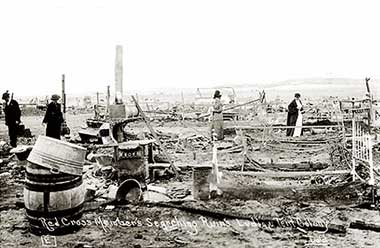
Red cross workers on the strikers' camp after the attack


In retaliation for Ludlow, the miners armed themselves and attacked dozens of mines over the next ten days, destroying property and engaging in several skirmishes with the Colorado National Guard along a 40-mile front from Trinidad to Walsenburg. The entire strike would cost between 69 and 199 lives, described as the "deadliest strike in the history of the United States".

The Ludlow Massacre was a watershed moment in American labor relations.
Historian Howard Zinn has described the Ludlow Massacre as "the culminating act of perhaps the most violent struggle between corporate power and laboring men in American history". Congress responded to public outcry by directing the House Committee on Mines and Mining to investigate the incident. Its report, published in 1915, was influential in promoting child labor laws and an eight-hour work day.

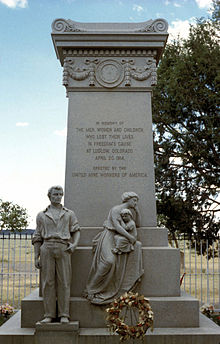
The Ludlow site, 12 miles (19 km) northwest of Trinidad, Colorado, is now a ghost town. The massacre site is owned by the UMWA, which erected a granite monument in memory of the miners and their families who died that day.[5] The Ludlow Tent Colony Site was designated a National Historic Landmark on January 16, 2009, and dedicated on June 28, 2009. Modern archeological investigation largely supports the strikers' reports of the event.

...

Mining was dangerous and difficult work. Colliers in Colorado were at constant risk for explosion, suffocation, and collapsing mine walls. In 1912, the death rate in Colorado's mines was 7.055 per 1,000 employees, compared to a national rate of 3.15...Miners were generally paid according to tonnage of coal produced, while so-called "dead work", such as shoring up unstable roofs, was often unpaid. According to historian Thomas G. Andrews, the tonnage system drove many poor and ambitious colliers to gamble with their lives by neglecting precautions and taking on risk, with consequences that were often fatal.
...
Colliers had little opportunity to air their grievances. Many colliers resided in company towns, in which all land, real estate, and amenities were owned by the mine operator, and which were expressly designed to inculcate loyalty and squelch dissent. Welfare Capitalists believed that anger and unrest among the workers could be placated by raising colliers' standard of living, while subsuming it under company management. Company towns indeed brought tangible improvements to the lives of many colliers and their families, including larger houses, better medical care, and broader access to education. However, ownership of the towns provided companies considerable control over all aspects of workers' lives, and this power was not always used to augment public welfare. Historian Philip S. Foner has described company towns as "feudal domain[s], with the company acting as lord and master. ... The 'law' consisted of the company rules. Curfews were imposed. Company guards - brutal thugs armed with machine guns and rifles loaded with soft-point bullets - would not admit any 'suspicious' stranger into the camp and would not permit any miner to leave." Furthermore, miners who raised the ire of the company were liable to find themselves and their families summarily evicted from their homes.
...
Frustrated by working conditions which they felt were unsafe and unjust, colliers increasingly turned to unionism. Nationwide, organized mines boasted 40 percent fewer fatalities than nonunion mines. Colorado miners had repeatedly attempted to unionize since the state's first strike in 1883. The Western Federation of Miners organized primarily hard rock miners in the gold and silver camps during the 1890s. Beginning in 1900, the UMWA began organizing coal miners in the western states, including southern Colorado. The UMWA decided to focus on the CF&I because of the company's harsh management tactics under the conservative and distant Rockefellers and other investors. To break or prevent strikes, the coal companies hired strike breakers, mainly from Mexico and southern and eastern Europe. CF&I's management mixed immigrants of different nationalities in the mines, a practice which discouraged communication that might lead to organization.

The strike was organized by the United Mine Workers of America (UMWA) against coal mining companies in Colorado. The three biggest mining companies were the Rockefeller family-owned Colorado Fuel & Iron Company (CF&I), the Rocky Mountain Fuel Company (RMF), and the Victor-American Fuel Company (VAF). Ludlow, located 12 miles (19 km) northwest of Trinidad, Colorado, is now a ghost town. The massacre site is owned by the UMWA, which erected a granite monument, in memory of the striking miners and their families who died that day.
...
Despite attempts to suppress union activity, secret organizing continued by the UMWA in the years leading up to 1913. Once everything had been laid out according to their plan, the UMWA presented, on behalf of coal miners, a list of seven demands:

-Recognition of the union as bargaining agent
-An increase in tonnage rates (equivalent to a 10% wage increase)
-Enforcement of the eight-hour work day law
-Payment for "dead work" (laying track, timbering, handling impurities, etc.)
-Weight-checkmen elected by the workers (to keep company weightmen honest)
-The right to use any store, and choose their boarding houses and doctors
-Strict enforcement of Colorado's laws (such as mine safety rules, abolition of scrip), and an end to the dreaded company guard system
.

The major coal companies rejected the demands and in September 1913, the UMWA called a strike. Those who went on strike were promptly evicted from their company homes, and they moved to tent villages prepared by the UMWA, with tents built on wood platforms and furnished with cast iron stoves on land leased by the union in preparation for a strike.

Confrontations between striking miners and replacement workers, referred to as "scabs" by the union, often got out of control, resulting in deaths. The company hired the Baldwin-Felts Detective Agency to help break the strike by protecting the replacement workers and otherwise making life difficult for the strikers.

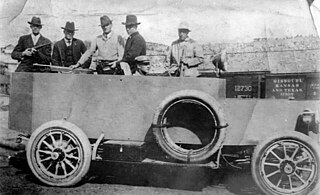
Baldwin-Felts had a reputation for aggressive strike breaking. Agents shone searchlights on the tenvillages at night and randomly fired into the tents, occasionally killing and maiming people. They used an improvised armored car, mounted with a M1895 Colt-Browning machine gun that the union called the "Death Special," to patrol the camp's perimeters. The steel-covered car was built in the CF&I plant in Pueblo from the chassis of a large touring sedan. Because of frequent sniping on the tent colonies, miners dug protective pits beneath the tents where they and their families could seek shelter.
...
As strike-related violence mounted, Colorado governor Elias M. Ammons called in the Colorado National Guard on October 28. At first, the Guard's appearance calmed the situation, but the sympathies of Guard leaders lay with company management. Guard Adjutant-General John Chase, who had served during the violent Cripple Creek strike 10 years earlier, imposed a harsh regime. On March 10, 1914, the body of a replacement worker was found on the railroad tracks near Forbes, Colorado. The National Guard said that the man had been murdered by the strikers. In retaliation, Chase ordered the Forbes tent colony destroyed. The attack was launched while the inhabitants were attending a funeral of infants who had died a few days earlier. The attack was witnessed by photographer Lou Dold, whose images of the destruction appear often in accounts of the strike.

The strikers persevered until the spring of 1914. By then, the state had run out of money to maintain the Guard, and was forced to recall them. The governor and the mining companies, fearing a breakdown in order, left two Guard units in southern Colorado and allowed the coal companies to finance a residual militia consisting largely of CF&I camp guards in National Guard uniforms.


On the morning of April 20, the day after Easter was celebrated by the many Greek immigrants at Ludlow, three Guardsmen appeared at the camp ordering the release of a man they claimed was being held against his will. This request prompted the camp leader, Louis Tikas, to meet with a local militia commander at the train station in Ludlow village, a half mile (0.8 km) from the colony. While this meeting was progressing, two companies of militia installed a machine gun on a ridge near the camp and took a position along a rail route about half a mile south of Ludlow. Anticipating trouble, Tikas ran back to the camp. The miners, fearing for the safety of their families, set out to flank the militia positions. A firefight soon broke out.


Coffins are marched through Trinidad, Colorado, at the funeral for victims of the Ludlow massacre

The fighting raged for the entire day. The militia was reinforced by non-uniformed mine guards later in the afternoon. At dusk, a passing freight train stopped on the tracks in front of the Guards' machine gun placements, allowing many of the miners and their families to escape to an outcrop of hills to the east called the "Black Hills." By 7:00 p.m., the camp was in flames, and the militia descended on it and began to search and loot the camp. Louis Tikas had remained in the camp the entire day and was still there when the fire started. Tikas and two other men were captured by the militia. Tikas and Lt. Karl Linderfelt, commander of one of two Guard companies, had confronted each other several times in the previous months. While two militiamen held Tikas, Linderfelt broke a rifle butt over his head. Tikas and the other two captured miners were later found shot dead. Tikas had been shot in the back. Their bodies lay along the Colorado and Southern Railway tracks for three days in full view of passing trains. The militia officers refused to allow them to be moved until a local of a railway union demanded the bodies be taken away for burial.

During the battle, four women and eleven children had been hiding in a pit beneath one tent, where they were trapped when the tent above them was set on fire. Two of the women and all of the children suffocated. These deaths became a rallying cry for the UMWA, who called the incident the "Ludlow Massacre."

In addition to the fire victims, Louis Tikas and the other men who were shot to death, three company guards and one militiaman were killed in the day's fighting.

Although the UMWA failed to win recognition by the company, the strike had a lasting impact both on conditions at the Colorado mines and on labor relations nationally. John D. Rockefeller, Jr. engaged labor relations experts, and future Canadian Prime Minister, W. L. Mackenzie King to help him develop reforms for the mines and towns, which included paved roads and recreational facilities, as well as worker representation on committees dealing with working conditions, safety, health, and recreation. There was to be no discrimination of workers who had belonged to unions, and the establishment of a company union. The Rockefeller plan was accepted by the miners in a vote. (this sort of compromise only dooms the workers to re-live over and over again the same kind of oppression  - my note)

Ludlow monument, erected by the United Mine Workers of America

Here are a few excerpts from Rockefeller's testimony, before the Congress:

CHAIRMAN: And you are willing to go on and let these killings take place . . . rather than go out there and see if you might do something to settle those conditions?

ROCKEFELLER: There is just one thing . . . which can be done, as things are at present, to settle this strike, and that is to unionize the camps; and our interest in labor is so profound . . . that interest demands that the camps shall be open [nonunion] camps that we expect to stand by the [Colorado Fuel and Iron Company] officers at any cost. . . .

CHAIRMAN: And you will do that if it costs all your property and kills all your employees?

ROCKEFELLER: It is a great principle.


Rockefeller's version of the events - June 10, 1914

"There was no Ludlow massacre. The engagement started as a desperate fight for life by two small squads of militia against the entire tent colony … There were no women or children shot by the authorities of the State or representatives of the operators … While this loss of life is profoundly to be regretted, it is unjust in the extreme to lay it at the door of the defenders of law and property, who were in no slightest way responsible for it."

Read more »
Read more »

Wednesday, February 8, 2012

Modern serfdom for the workers, endless money-printing and gold as the ultimate anti-investment


Assuming that we've read some of our previous "big picture" posts (for example here and here), you probably know that gold has a "special role" to play in today's situation - it is no accident that it's exchange rate vs the dollar and all the other fiat currencies of the world has been rising for the last 10 years or so.

Some may say that "gold is a bubble", but this is not true. The only "bubblish" about gold is the "paper gold" market, that the capitalists have created (this is a subject that we shall discuss in a few days). But physical gold is humanity's "truest" form of money. Ever since private property and trade appeared, people have being exchanging goods and services, and they soon realized that they needed to replace the barter system with a new system, which would employ a new invention, money. Money is a "super-product" that is used as a "benchmark" for all other products: All other goods have a value that can now be expressed through it.

Mankind has used many different forms of money, but gold (and secondarily silver) is the form that dominated over all the other forms. The reason is that gold is durable, easily transferable from one place to another and rare. Many other forms of money where tried, but nothing could beat gold's advantages as money.

However, ever since Nixon took us off the gold standard, people's perceptions changed a lot: In recent years, gold has been considered somewhat of a "fringe investment", and despite the fact that the world's central banks still keep tonnes of gold (and only gold, not diamonds, nor any other precious metal or commodity) in their vaults, people have almost stopped thinking of gold as money.

"Although gold and silver are not by nature money, money is by nature gold and silver."
-Karl Marx

"Gold is Money. Everything Else is Credit."
-J.P. Morgan

It is true that gold has other uses (for example, it is used in industry and in making jewelry), but it is also used as money - so, the value of everything else can be expressed through gold.

Everything else is credit,
as JP Morgan famously declared almost a century ago.

So, in today's world, where everything's value is expressed in dollars (or euros, etc.), we are in fact using a leveraged form of "money": currency.

We have already explained how and why we got here in previous posts. Now it's time to also make "an educated guess" about where we are going next - here are some thoughts on the subject:


1) Capitalism is based on the exploitation of the workers by the capitalists.

2) After the collapse of the former USSR, all the workers of the Soviet block + the Chinese workers were intergraded into the labor marker that truly became global.

3) Capitalists off-shored production to Asia, as the workers of those countries could be exploited much more so than the workers of the West (as the Western workers had achieved some important victories through a century of labor struggles, that inhibited the capitalists ability to exploit them).

4) As the industrial base of the West was diminishing, capitalism became more "leveraged" and credit-based, as it needed more and more "banking loans" to keep the system going:
-If a factory was closed down, either because the owner off-shored production to Asia or because it just couldn't compete against the cheaper goods that were made in China, the workers of that factory could still get a job, or start a business themselves, by getting a loan from the banks.
-The workers wages have stagnated for a long time (link), but they could still "afford" a new house, by getting a mortgage. And they could also afford rising tuition fees for their children's education, by getting a student loan. And they could even a new plasma TV set, by getting another "consumer's loan". And the list goes on and on.
-This meant that the construction workers could find a job (thanks to all these mortgages), and the companies that produce this plasma TV set and the merchants who sell this TV would make a profit. So, there would be a job for those who make these TV sets, or sell them.

5) The problem with all this is that the houses that the people live in are not "their" houses, they belong to the bank. And if you can't make your payment on your mortgage, then the bank kicks you out. Can all these debts be repaid? No, of course not.

6) So, the Western workers earn relatively low wages, and are deeply in debt, as they had to keep the system going by "overconsuming" for a very long time. And it's not just the workers, entire states are heavily indebted and cannot possibly repay their debts.

7) As the people cannot get any more loans, capitalism can't keep growing. No jobs for the construction workers, factories close down as noone can consume all the good that they produce, etc.

8) But as these debts cannot be repaid, the banks are also in trouble, as they have to write down heavy losses. This is a very heavy blow for them, as they are ALL bankrupt, just like Lehman Brothers.

9) The difference is that, unlike Lehman (and a lot of smaller banks), the rest of the banks were saves through endless bailouts. Let's not forget that the banks have become bigger than ever, as capitalism needed more and more credit. So, the bankers have the politicians in their pockets, and they managed to get the money they needed (from us). After all, they are "too big to fail", whereas we are not, we are "replaceable". So, all the wealth of our societies is being redirected to the banks, in order to cover their losses, leaving the rest of us to starve.

10) But the banks need a lot of dollars. Trillions and trillions of them. So, this "money" is being "created out of thin air" (quantitative easing - money printing). This process of money printing has being going on for many decades now, ever since Nixon abolished the gold standard. The system needed more credit, and so it became more leveraged. The gold standard was interfering with capitalism's need for increased leverage, so they abolished it. And now that the banks have to be bailed out, they are printing even more money than before - here's a great chart:


11) All this newly created "money" (currency) goes to the banks, so that they won't have to face another "Lehman-type" moment, or even a global collapse of the entire banking sector. But this newly created 'money' isn't based on newly created wealth (new products/services), nor on wealth's"monetary counterpart", gold (gold, as we have already explained, is the "monetary representation" of wealth, as capitalism has a tendency to monetize everything, and so all goods and services have a value that can now be expressed through gold, in order for the people to be able to exchange them in the market (buying/selling).

12)
As all this newly created "money" is not based on new wealth/gold, it is simply a way to debase the currency and redistribute wealth:
The banks get bailed out, by getting all the newly created "money", and the workers get paid less (as the value of the currency in which they are getting paid is being diminished). This is necessary for the capitalists, who get to save the banks, and improve the "competitiveness" of the working class. The destruction the currencies is a sacrifice that they have to make, in order to save the banking sector from collapsing, and at the same time to reduce the wages of the wokers, so that they become "more competitive", thus attracting capital investments.

13) One of the greatest "side-effects" of this process of "money printing" is that fewer and fewer people want to own/use the various currencies, as they can easily understand that these currencies will lose a lot of their current value in the future. More and more capitalists turn to gold for protection of their wealth, as they realize that gold is the one thing that will always remain constant. So, China, Russia, the oil states (and many other rich "players") are buying gold, and they are trying to dump the dollar when they trade with each other. The oil states have a "special role" to play in all this, because if and when they reject the dollar as a means of payment, the world will experience a great "oil crisis", much bigger than the 1973 oil crisis (which was the first time the oil states publickly rejected the dollar and demanded to be paid in gold, as they obviously didn't like America's decision to abolish the gold standard in order to print as many dollars as the USA wanted).


13) The West is obviously caught between a rock and a hard place. But saving the banks and impoverishing the workers are the top priorities, so this process of "money-printing" will continue, despite the various obstacles, twists and turns. Money printing is today a "systemic necessity" for capitalism, and there is not much point in putting the blame solely on Bernanke, Obama, Bush, the FED or their English/Japanese/European counterparts (The Europeans are also printing money, although Germany does not need the same amounts of "money-printing" as the rest of Europe, as the German workers are already very competitive, thanks to their high productivity. But Germany also accepts the need for money-printing, as it is the only way to save the banks from their "toxic loan situation". And they are VERY WELL PREPARED for the coming destruction of the dollar (hyperinflation), as the euro-system has combined the European nation's gold, making it the "least bad" option in a world of fiat currencies that are being massively debased).

14) But gold is not just an inflation hedge or a deflation hedge - it is a measure of trust in the system: The reason why gold was considered to be a "fringe investment", or even "a thing of the past" is because there was a lot of trust the system's ability to grow. The capitalists don't really like gold's stability, because capitalism wants to constantly expand. So, the capitalists prefer investments that return a profit for them, like starting a business, or investing in stocks, etc.. If and when the economy is doing well, then businesses make profits, investing on stocks is also profitable, etc. So why buy gold? Why would anyone want to save his capital for another day, when he can invest his capital today, and make a lot of money?

15) Things change however, and today the capitalists are not very confident that the economy will grow in the future (there is no trust in the system). There is enough capital concentrated in the hands of a few oligarchs, and there are many cheap workers in Asia - and yet the capitalists are NOT willing to make a lot of investments (especially in the West, where the workers are "too expensive"). As the workers lack the necessary "purchasing power" to buy things, it is obvious that a lot of products will not be consumed (because the people are too poor to buy them).

16) But the capitalists prefer to let the workers starve to death, even if this aggrevates the crisis on the short-term. The more desperate the workers become, the more inclined they will be to accept serfdom (or "increased competitiveness", as the capitalists see it). So even if a few capitalists get killed in the process ("coladeral damage"), the end result will be great for the rulling class, as they will have created an "ultra-competitive" world, where a few oligarchs own almost everything, and the workers work for scraps (->more profits for the capitalists). It is only then that they will start investing again (especially in the West). Until thw workers accept working for scraps, the capitalists will not invest.

17) In order to achieve this goal, the capitalists need a safe place to store their capital: GOLD. Once the workers have become "desperate enough" to accept serfdom, the "business cycle" can start again, and they will invest some of their gold in productive investments. But until they feel confident that they will make a profit, they choose to save their capital for the future - and gold is the only thing that will not lose value when everything else is collapsing.


Here is a great piece written almost a year ago by James Saft on Reuters - he really seems to be on to something:

Triumph of gold, the anti-investment
Rather than being an anti-currency, gold is really an anti-investment, not because it can’t pay off, but because it is the one asset that not only protects you against the bad actions of others but actually rewards you for them.

If central bankers and politicians bring on massive inflation, gold goes up. If the U.S. threatens to slouch or leap towards default, gold goes up.

The opposite of buying gold perhaps is to buy equities, because you are betting on creating products, jobs and wealth rather than just protecting yourself.
On the other hand, a bar of gold has no executives that can loot the company or accountants that can aid in fraud. Really the world in which an investment in gold makes you rich is not a very appealing place.
[...]
Gold, then, is a profoundly pessimistic and depressing investment. In current circumstances it also, unfortunately, has a heck of an elevator pitch.
[...]
In investing, extreme behavior is becoming more mainstream every day.

How else can we interpret the extraordinary moves by the University of Texas’ endowment fund to not only buy nearly $1 billion of gold, equal to about 5 percent of its assets, but to insist on taking physical delivery of the precious metal.

It is really hard to say which is more remarkable; that people are behaving in ways that might have been labeled as paranoid a few years ago or the rise of things that plausibly might make them worried.


Garbage - Only Happy When It Rains

I'm only happy when it rains
I'm only happy when it's complicated
And though I know you can't appreciate it
I'm only happy when it rains
You know I love it when the news is bad
And why it feels so good to feel so sad
I'm only happy when it rains

Pour your misery down, pour your misery down on me

I'm only happy when it rains
I feel good when things are going wrong
I only listen to the sad sad songs
I'm only happy when it rains

I only smile in the dark
My only comfort is the night gone black
I didn't accidentally tell you that
I'm only happy when it rains
You'll get the message by the time I'm through
When I complain about me and you
I'm only happy when it rains

Pour your misery down,
(pour your misery down on me)
Pour your misery down,
(pour your misery down on me)
Pour your misery down,
(pour your misery down on me)
Pour your misery down,
(pour your misery down on me)
Pour your misery down
You can keep me company as long as you don't care

I'm only happy when it rains
You wanna hear about my new obsession
I'm riding high upon a deep depression
I'm only happy when it rains

(Pour some misery down on me)
I'm only happy when it rains
(Pour some misery down on me)
I'm only happy when it rains
(Pour some misery down on me)
I'm only happy when it rains
(Pour some misery down on me)
I'm only happy when it rains

(Pour some misery down on me)

I'm only happy when it rains
(Pour some misery down on me)
I'm only happy when it rains
(Pour some misery down on me)
I'm only happy when it rains
(Pour some misery down on me)
Read more »
Read more »

Monday, February 6, 2012

"Moral capitalism" and the rise of the "overclass"

A few days ago, English Prime Minister David Cameron made a speech on..."moral capitalism". There has been much talk about "reforming the system", and "doing something" about "the excesses" of the "golden boys" that led us where we are today. For the time being of course, all this talk is...just talk.

But, as history has proven, capitalism CAN make some "adjustments" - indeed, capitalism made some important reforms during the 1929 Great Crash (for example by breaking up the big banks, etc.).

But those reforms can only happen if the capitalists are pressured by the people. During the 1929 crisis, the worker's movement was much stronger than it is today, and communism was not a failed idea of the past. So, there was a lot more pressure by the people, and the capitalists had to make some concessions. And so they did.


What about today? Well, the capitalists don't really seem to be too bothered by the protests so far. But as the people become more and more aware of how their masters are bailing themselves out and leave nothing but scraps for the rest of us, they get more and more angry. So, the politicians of the ruling class start making promises to "do something" about the bonuses of the "golden boys" (who would have gone bankrupt if it wasn't for them). Of course, the only thing that the governments would have to do in order to punish the "golden boys" would be to stop the bailouts. But that's obviously “out of the question”, as the banks would all go bankrupt in an instant if that were to happen.

So, the theatrics begin in order to convince the masses that they are “doing something” to “fix the problem”:

-The politicians make speeches about "moral capitalism"
, and the "excesses" of the banks that led us here (when in fact those "excesses" (the huge loans that were handed out by the banks) were the substitute that the capitalists used in order to "mask" the industrial capital's flight to Asia for over 20 years now - the true "root cause" of the crisis, is capitalism's endless thirst for more and more profits at the expense of the workers).

-The “fat cats” promise to "behave themselves" from now on, and some of them actually do. But that doesn't last long, as history shows - for example, the big banks that were broken up during the 1929 crisis have now become bigger than ever. That’s what happens if your are successful at achieving your goal (more profits). You become bigger and bigger.

-Some bankers, financial speculators, politicians and industrial capitalists may even go to jail, or at least pay a big fine for breaking a few laws here and there, in order to maximize their profits. They will be used as a sacrificial lamb to appease an offended populace, while the system that produced them remains relatively intact.

And this vicious cycle will go on and on...
Unless the working class realizes that the world would be a much better place without those who exploit us. But in order to overthrow them, we, the workers, must have the ability to rule the world for ourselves, instead of being dependant on out masters. Are we ready to do that? Because if we are not, then our masters are quite content to keep doing what they do best: Being rich (and getting richer) at our expense.


The rise of the overclass
We’ve all heard of the 'underclass’: now its mirror image – a super-rich elite that is equally cut off from the rest of us – is defining the political debate.

When Labour leader Ed Miliband used his conference speech last September to call for a fairer and more humane type of capitalism, he was greeted with widespread derision and mockery. But four months on, every leading politician in Britain is desperately trying to follow Miliband’s lead. What constitutes a fair society is no longer just a matter for academic theorists. Suddenly it’s the hottest subject in politics.

The reason is simple: growing public revulsion at a new class of super-rich who seem to be immune from the restraints that govern the lives of ordinary people. Senior bankers, private equity moguls and hedge fund managers appear cut off from the rest of us. They often pay little or no tax, increasingly live in heavily guarded enclaves, and some have little or no real allegiance to Britain. The sources of their wealth are often mysterious, and appear unrelated to merit. These feral rich pose, in their way, every bit as much of a danger to society as the rioters who stole and pillaged London streets last August.

Taxpayers spent £60 billion bailing out City bankers to save them from bankruptcy. Yet, rather than displaying contrition or gratitude, these bankers continue to pay themselves multi-million pound salaries, unimaginable sums of money to most of us.

The injustice is glaring – all the more so in a time of grinding national austerity, when living standards are falling and unemployment is rising. No wonder that, this week, David Cameron – who loves to claim that “we’re all in this together” – entered the fray with a speech trying to define what he called “responsible capitalism”. He senses that this is an issue where the Right is hugely vulnerable

The New American Divide
America is coming apart. For most of our nation's history, whatever the inequality in wealth between the richest and poorest citizens, we maintained a cultural equality known nowhere else in the world—for whites, anyway. "The more opulent citizens take great care not to stand aloof from the people," wrote Alexis de Tocqueville, the great chronicler of American democracy, in the 1830s. "On the contrary, they constantly keep on easy terms with the lower classes: They listen to them, they speak to them every day."

Americans love to see themselves this way. But there's a problem: It's not true anymore, and it has been progressively less true since the 1960s.
[...]
Over the past 50 years, that common civic culture has unraveled. We have developed a new upper class with advanced educations, often obtained at elite schools, sharing tastes and preferences that set them apart from mainstream America. At the same time, we have developed a new lower class, characterized not by poverty but by withdrawal from America's core cultural institutions.
[..]
The primary indicator of the erosion of industriousness in the working class is the increase of prime-age males with no more than a high school education who say they are not available for work—they are "out of the labor force." That percentage went from a low of 3% in 1968 to 12% in 2008. Twelve percent may not sound like much until you think about the men we're talking about: in the prime of their working lives, their 30s and 40s, when, according to hallowed American tradition, every American man is working or looking for work. Almost one out of eight now aren't. Meanwhile, not much has changed among males with college educations. Only 3% were out of the labor force in 2008. 
 The Remarkable Political Stupidity of the Street
The Street’s biggest lobbying groups have just filed a lawsuit against the Commodities Futures Trading Commission, seeking to overturn its new rule limiting speculative trading.

For years Wall Street has speculated like mad in futures markets – food, oil, other commodities – causing prices to fluctuate wildly. The Street makes bundles from these gyrations, but they have raised costs for consumers.

In other words, a small portion of what you and I pay for food and energy has been going into the pockets of Wall Street. It’s just another hidden redistribution from the middle class and poor to the rich.


The new Dodd-Frank law authorizes the Commodity Futures Trading Commission to limit such speculative trading. The commission considered 15,000 comments, largely from the Street. It did numerous economic and policy analyses, carefully weighing the benefits to the public of the new regulation against its costs to the Street. It even agreed to delay enforcement of the new rule for at least a year.

But this wasn’t enough for the Street. The new regulation would still put a crimp in Wall Street’s profits.

So the Street is going to court. What’s its argument? The commission’s cost-benefit analysis wasn’t adequate. 

Revealed: bankers' secret meetings with ministers
The full scale of big banks' lobbying of the Chancellor, George Osborne, to get him to water down banking reforms can be revealed today. Senior bank executives met or called Treasury ministers nine times in the weeks after Sir John Vickers published his landmark proposals on how to prevent another banking crisis, The Independent can reveal.

Bank bosses are fighting furiously behind the scenes to limit any changes to the way they do business. Fears are growing – articulated by Sir John himself – that the banks are successfully thwarting the Government's plans to overhaul the British banking system and the Treasury is weakening some of the key reforms as a result of intense lobbying.

Revolving Door: From Top Futures Regulator to Top Futures Lobbyist
While America focused on New Hampshire, a classic example of revolving-door politics took place in Washington, going almost completely unnoticed. It’s a move that ranks up there with the hire of Louisiana congressman Billy Tauzin to head the pharmaceutical lobbying conglomerate PhRMA -- at a salary of over $2 million a year -- immediately after Tauzin helped ram through the Medicare Prescription Drug Bill, a huge handout to the pharmaceutical industry.

In this case, the hire involves Walter Lukken, who toward the end of the Bush years was the acting head of the Commodity Futures Trading Commission. As the chief regulator of the commodities markets, it was Lukken’s job to spot and combat speculative abuses and manipulations that might have led to artificial price hikes and other disruptions. 


HUSSMAN: 'Wall Street Is Little More Than A Glorified Crack House'
Frankly, I am concerned that Wall Street is becoming little more than a glorified crack house. Day after day, the sole focus of Wall Street is on more sugar, stronger sugar, Big Bazookas of sugar, unlimited sugar, and anything that will get somebody to deliver the sugar faster. This is like offering a lollipop to quiet down a 2-year old throwing a tantrum, and expecting that the result will be fewer tantrums.

What we have increasingly observed over the past decade is nothing but the gradual destruction of the ability of the financial markets to allocate capital for the benefit of future growth.

Nietzsche famously said "What does not kill me makes me stronger." The corollary is "What constantly rescues me makes me weaker." The world will only stop looking for bailouts when policy makers stop handing them out.

“And the great owners, who must lose their land in an upheaval, the great owners with access to history, with eyes to read history and to know the great fact: when property accumulates in too few hands it is taken away. And that companion fact: when a majority of the people are hungry and cold they will take by force what they need. And the little screaming fact that sounds through all history: repression works only to strengthen and knit the repressed.”
-John Steinbeck
Read more »
Read more »

Paul Lafargue - The Bankruptcy of Capitalism


Paul Lafargue - The Bankruptcy of Capitalism (1900)
 The nineteenth century was the century of capitalism. Capitalism filled that century to overflowing with its commerce, its industry, its manners, its fashions, its literature, its art, its science, its philosophy, its religion, its politics and its civil code, more universal than the laws imposed by Rome upon the nations of the ancient world. The capitalist movement, starting from England, the United States and France, has shaken the foundations of Europe and of the world. It has forced the old feudal monarchies of Austria and Germany and the barbaric despotism of Russia to put themselves in line; and in these last days it has gone into the extreme East, into Japan, where it has overthrown the feudal system and implanted the industry and the politics of capitalism.

Capitalism has taken possession of our planet; its fleets bring together the continents which oceans had separated; its railroads, spanning mountains and deserts, furrow the earth; the electric wires, the nervous system of the globe, bind all nations together, and their palpitations reverberate in the great centers of population. Now for the first time there is a contemporary history of the world. Events in Australia, the Transvaal, China, are known in London, Paris, New York, at the moment they are brought about, precisely as if they happened in the outskirts of the city where the news is published.

Civilized nations live off the products of the whole earth. Egypt, India, Louisiana, furnish the cotton, Australia the wool. Japan the silk, China the tea, Brazil the coffee, New Zealand and the United States the meat and grain. The capitalist carries in his stomach and on his back the spoils of the universe.

The study of natural phenomena has undergone an unprecedented, an unheard-of, development. New sciences, geology, chemistry, physics, etc., have arisen. The industrial application of the forces of nature and of the discoveries of science has taken on a still more startling development; some of the geometrical discoveries of the scientists of Alexandria, two thousand years old, have for the first time been utilized.

The production of machine industry can provide for all demand and more. The mechanical application of the forces of nature has increased man’s productive forces tenfold, a hundredfold. A few hours’ daily labor, furnished by the able-bodied members of the nation, would produce enough to satisfy the material and intellectual needs of all.

But what has come of the colossal and wonderful development of science, industry and commerce in the nineteenth century? Has it made humanity stronger, healthier, happier? Has it given leisure to the producers? Has it brought comfort and contentment to the people?

Never has work been so prolonged, so exhausting, so injurious to man's body and so fatal to his intelligence. Never has the industrial labor which undermines health, shortens life and starves the intellect been so general, been imposed on such ever-growing masses of laborers. The men, women and children of the proletariat are bent under the iron yoke of machine industry. Poverty is their reward when they work, starvation when they lose their jobs.

In former stages of society, famine appeared only when the earth refused her harvests. In capitalist society, famine sits at the hearth of the working class when granaries and cellars burst with the fruits of the earth, and when the market is gorged with the products of industry.

All the toil, all the production, all the suffering of the working class has but served to heighten its physical and mental destitution, to drag it down from poverty into wretchedness.

Capitalism, controlling the means of production and directing the social and political life of a century of science and industry, has become bankrupt. The capitalists have not even proved competent, like the owners of chattel slaves, to guarantee to their toilers the work to provide their miserable livelihood; capitalism massacred them when they dared demand the right to work – a slave’s right.

The capitalist class has also made a failure of itself. It has seized upon the social wealth to enjoy it, and never was the ruling class more incapable of enjoyment. The newly rich, those who have built up their fortunes by accumulating the filchings from labor, live like strangers in the midst of luxury and artistic treasures, with which they surround themselves through a foolish vanity, to pay homage to their millions.

The leading capitalists, the millionaires and billionaires, are sad specimens of the human race, useless and hurtful. The mark of degeneracy is upon them. Their sickly offspring are old at birth. Their organs are sapped with diseases. Exquisite meats and wines load down their tables, but the stomach refuses to digest them; women expert in love perfume their couches with youth and beauty, but their senses are benumbed. They own palatial dwellings in enchanting sites, and they have no eyes, no feeling for joyful nature, with its eternal youth and change. Sated and disgusted with everything, they are followed everywhere by ennui as by their shadows. They yawn at rising and when they go to bed. They yawn at their fests and at their orgies. The began yawning in their mother’s womb.

The pessimism which, in the wake of capitalist property, made its appearance in ancient Greece six centuries before Jesus Christ, and which has since formed the foundation of the moral and religious philosophy of the capitalist class, became the leading characteristic of the philosophy of the second half of the nineteenth century. The pessimism of Theognis sprang from the uncertainties and vicissitudes of life in the Greek cities, torn by the perpetual wars between rich and poor; the pessimism of the capitalist is the bitter fruit of satiety, ennui and the impoverishment of the blood.

The capitalist class is falling into its second childhood; its decreptitude appears in its literature, now returning to its starting point. Romantic literature, the literary form proper to the capitalist class, which started out with the romantic Christianity of Chateaubriand, is returning to the same point, after passing through the historical novel and the character novel. Capitalism, which in its virile and combative youth in the eighteenth century had wished to emancipate itself from Christianity, resigns itself in its old age to practices of the grossest superstition.

The capitalist class, bankrupt, old, useless and hurtful, has finished its historic mission; it persists as ruling class only through its acquired momentum. The proletariat of the twentieth century will execute the decree of history; will drive it from its position of social control. Then the stupendous work in science and industry accomplished by civilized humanity, at the price of such toil and suffering, will engender peace and happiness; then will this vale of tears be transformed into an earthly paradise.
Read more »
Read more »

Sunday, February 5, 2012

Why do some GOP party politicians envision a China-like America?


A few weeks ago, Huffington Post published a very interesting article titled "Emerging GOP View: Communist China Is Model for American Capitalism". The article discusses a growing trend amongst US capitalists, especially those who favor the Republican party, to view China as an example that the USA needs to follow. Here are some key quotes from the Huffington Post article:
First came Rep. Mike Coffman who wrote in May that China has "enjoyed sustained economic growth based on the free market principles that we have long abandoned in favor of the redistributionist policies of a welfare state."

Then in November, Michele Bachmann said, essentially, that China is growing like crazy because it lacks America's Great Society programs, which she'd dump.

And now yesterday, according to a tweet by AFP reporter Olivier Knox, Mitt Romney held up China as a place where people are getting rich on free enterprise and capitalism, while, by implication, Americans are watching on the sidelines getting poor
There are many monopolies in China, and a lot of state regulation (especially when it comes to "regulating" the workers rights, so that the capitalists can "freely" make huge profits). So there is not much point in seriously debating whether or not China is based on "free markets".

But still, China IS growing, and it does attract capital investments like no other country. We have discussed of course (in previous posts) how China is also heading for a crisis, as the Chinese workers are 'too poor' to buy all the products they produce, and as the Westerners can't keep buying them anymore (because they are getting poor), Chinese exports will suffer. Or that there are increasing signs of a Chinese property and housing bubble, as the workers can't buy all the houses they have built (because they are too poor). But China will probably get over any crisis in he long run, because it can attract investments (unlike the Western countries, with the exception of Germany).

We even remembered John Stapleton, an English Liberal Party politician who sat in the House of Commons between 1852 and 1874 - here's a famous quote of his: "If China," says Mr. Stapleton, M.P., to his constituents, "should become a great manufacturing country, I do not see how the manufacturing population of Europe could sustain the contest without descending to the level of their competitors." (Times, Sept. 3, 1873, p. 8.).

But hey, who cares if some workers live or die? In fact, from a capitalist's point of view, if when a crisis hits, then it makes a lot of sense to let some workers suffer or even die, as they can easily be replaced (there are billions of them). So, if some of them die, then there is no problem - on the contrary, their deaths would help keep the unemployment rate lower.

"Know your place in the universe" as the saying goes - but what is a workers place in the universe? Here is FOXCONN's CEO on the subject:

CEO OF APPLE PARTNER FOXCONN: 'Managing One Million Animals Gives Me A Headache'
According to WantChinaTimes, Terry Gou, the head of Hon Hai (Foxconn), the largest contract manufacturer in the world, had this to say at a recent meeting with his senior managers:

"Hon Hai has a workforce of over one million worldwide and as human beings are also animals, to manage one million animals gives me a headache," said Hon Hai chairman Terry Gou at a recent year-end party, adding that he wants to learn from Chin Shih-chien, director of Taipei Zoo, regarding how animals should be managed.

As WantChinaTimes put it, Gou "could have chosen his words more carefully." But Gou had indeed invited the zoo director to speak to Hon Hai's top managers in the hope that the zoo-keeper's advice would help them do their jobs better
So, why does China attracts investments? And why does the GOP want to emulate the Chinese model?

It's simple: It's not just the low wages or the long working hours. It's not even the fact that the new generation of Chinese workers is more skilled and educated than the previous ones.

It's also because the workers have no rights, not really. They pretty much do whatever the capitalists order them to do in order to increase productivity and their profits. And if they have the "audacity" to make some demands, then they are fired or the state sends in the police or the army and crack down on protesters. There is no "free speech", and the list goes on and on.


So, the Western capitalists have billions of "man-animals" in China, so they simply have no use for the Western workers, not all of them anyway. And, naturally, they just let them rot, die, while the rest have to accept "austerity measures", that force them to work longer hours for less money. They become "Chinafied" - after all, this is what the GOP members want to do, right? They don't like "the redistributionist policies of a welfare state", because there is no way to compete against China if your workers are living in relatively "humane" conditions", while the Chinese workers are treated like "animals". Capitalism has reached a point where it can only grow in a "China-like business environment" (Germany being the one notable exception).

So, if humanity is to keep forcing the workers to compete against each other, for the sake of a few capitalists, then this is what happens:
If you are a worker, you'll have to accept a very low wage, working long hours, etc., or you'll have to face massive unemployment, as the capitalists can invest their capital in other places (wherever the workers DO accept living in poverty).

YES, there are some notable exceptions to this - for example Germany is doing pretty well, as it produces better quality products to make up for the relatively "high" German wages. But the general trend is clear: China is the new row model for the capitalists, and the workers have an important choice to make - They can either accept living like "animals", or they can overthrow the capitalists, who make us compete against each other, for their benefit and their benefit alone.

Here is what you, as a worker, have to compete against (from the "New York Times"):

This Article Explains Why Apple Makes iPhones In China And Why The US Is Screwed
When one reads about these working conditions — 12-16 hour shifts, pay of ~$1 per hour or less, dormitories with 15 beds in 12x12 rooms — the obvious assumption is that it's all about money:

Greedy manufacturers want to make bigger profits, so they make their products in places with labor practices that would be illegal in America.

And money is certainly part of it.


But an amazing new article by Charles Duhigg and Keith Bradsher of the New York Times reveals that there's a lot more to it than that.

Most of the components of iPhones and iPads — the supply chain — are now manufactured in China, so assembling the phones half-a-world away would create huge logistical challenges. It would also reduce flexibility — the ability to switch easily from one component supplier or manufacturer to another.

China's factories are now far bigger and more nimble than those in the United States. They can hire (and fire) tens of thousands of workers practically overnight. Because so many of the workers live on-site, they can also press them into service at a moment's notice. And they can change production practices and speeds extremely rapidly.
China now has a far bigger supply of appropriately-qualified engineers than the U.S. does — folks with the technical skills necessary to build complex gadgets but not so credentialed that they cost too much.


And, lastly, China's workforce is much hungrier and more frugal than many of their counterparts in the United States.

On this last point, Duhigg and Bradsher tell the story of Eric Saragoza, an engineer who began working in an Apple factory near Sacramento in 1995. The plant made Macs, and for a few years, Saragoza did well, earning $50,000 a year, getting married and having kids, and buying a house with a pool.

Soon, however, Apple started shipping jobs overseas, because the costs of manufacturing in Asia were so much lower. Importantly, these reduced costs weren't just about wages — they were about being closer to the supply chain and the willingness of the workforce to put in over-time.

Saragoza was soon asked to work 12-hour days and come in on Saturdays. But, understandably, he wanted to watch his kids play soccer on the weekends.

Saragoza's salary was too high for him to take an unskilled job. And he didn't have the experience and credentials necessary to move into senior management. In 2002, his job was eliminated. Apple, meanwhile, turned the Elk Grove plant into an AppleCare facility, with call-center employees making $12 an hour.


Recently, desperate for work, Saragoza took a job at an electronics temp firm. Assigned to the AppleCare plant, he was paid $10 an hour to test repaired iPads before they were sent back to customers. That job paid so little (and was presumably so depressing) that the now 48-year-old Saragoza quit and is looking for work again.

Meanwhile, in Shenzhen, a young project manager named Lina Lin coordinates the manufacture of Apple accessories for a company in the Apple ecosystem. She makes a bit less than Saragoza made a decade ago as an Apple engineer. She lives in an 1,100-square foot apartment with her husband, their in-laws, and their son. They save a quarter of their salaries every month.
Your iPhone Was Built, In Part, By 13 Year-Olds Working 16 Hours A Day For 70 Cents An Hour

  • One Foxconn worker Mike Daisey interviewed, outside factory gates manned by guards with guns, was a 13-year old girl. She polished the glass of thousands of new iPhones a day.
  • The 13-year old said Foxconn doesn't really check ages. There are on-site inspections, from time to time, but Foxconn always knows when they're happening. And before the inspectors arrive, Foxconn just replaces the young-looking workers with older ones.
  • In the first two hours outside the factory gates, Daisey meets workers who say they are 14, 13, and 12 years old (along with plenty of older ones). Daisey estimates that about 5% of the workers he talked to were underage.
  • Daisey assumes that Apple, obsessed as it is with details, must know this. Or, if they don't, it's because they don't want to know.
  • Daisey visits other Shenzhen factories, posing as a potential customer. He discovers that most of the factory floors are vast rooms filled with 20,000-30,000 workers apiece. The rooms are quiet: There's no machinery, and there's no talking allowed. When labor costs so little, there's no reason to build anything other than by hand.
  • A Chinese working "hour" is 60 minutes — unlike an American "hour," which generally includes breaks for Facebook, the bathroom, a phone call, and some conversation. The official work day in China is 8 hours long, but the standard shift is 12 hours. Generally, these shifts extend to 14-16 hours, especially when there's a hot new gadget to build. While Daisey is in Shenzhen, a Foxconn worker dies after working a 34-hour shift.
  • Assembly lines can only move as fast as their slowest worker, so all the workers are watched (with cameras). Most people stand.
  • The workers stay in dormitories. In a 12-by-12 cement cube of a room, Daisey counts 15 beds, stacked like drawers up to the ceiling. Normal-sized Americans would not fit in them.
  • Unions are illegal in China. Anyone found trying to unionize is sent to prison.
  • Daisey interviews dozens of (former) workers who are secretly supporting a union. One group talked about using "hexane," an iPhone screen cleaner. Hexane evaporates faster than other screen cleaners, which allows the production line to go faster. Hexane is also a neuro-toxin. The hands of the workers who tell him about it shake uncontrollably.
  • Some workers can no longer work because their hands have been destroyed by doing the same thing hundreds of thousands of times over many years (mega-carpal-tunnel). This could have been avoided if the workers had merely shifted jobs. Once the workers' hands no longer work, obviously, they're canned.
  • One former worker had asked her company to pay her overtime, and when her company refused, she went to the labor board. The labor board put her on a black list that was circulated to every company in the area. The workers on the black list are branded "troublemakers" and companies won't hire them.
  • One man got his hand crushed in a metal press at Foxconn. Foxconn did not give him medical attention. When the man's hand healed, it no longer worked. So they fired him. (Fortunately, the man was able to get a new job, at a wood-working plant. The hours are much better there, he says — only 70 hours a week).
  • The man, by the way, made the metal casings of iPads at Foxconn. Daisey showed him his iPad. The man had never seen one before. He held it and played with it. He said it was "magic."
 Nike factory to pay $1m to Indonesian workers for overtime
Shoe plant workers clocked up nearly 600,000 hours of overtime without pay over two years

A Nike factory has agreed to pay $1m in unpaid overtime to Indonesian workers in a move that could force other suppliers of multinational companies to follow suit.

"This has the potential to send shockwaves through the Indonesian labour movement," he said, adding that the victory had prepared the union to take on the fight for any workers who had been forced to work overtime without pay. "We have only just begun." 
Read more »
Read more »

The ‘manure’ of history


Something has changed, fundamentally. This is evident. What is it?

Before, they all wanted to be the ploughmen of history, to play the active parts, each one of them to play an active part. Nobody wished to be the ‘manure’ of history. But is it possible to plough without first manuring the land? So ploughmen and ‘manure’ are both necessary. In the abstract, they all admitted it. But in practice? Manure for manure, as well draw back, return to the shadows, into obscurity. Now something has changed, since there are those who adapt themselves ‘philosophically’ to being ‘manure’, who know this is what they must be and adapt themselves. It is like the problem of the proverbial dying man.

But there is a great difference, because at the point of death what is involved is a decisive action, of an instant’s duration. Whereas in the case of the manure, the problem is a long-term one, and poses itself afresh at every moment. You only live once, as the saying goes; your own personality is irreplaceable. You are not faced abruptly with an instant’s choice on which to gamble, a choice in which you have to evaluate the alternatives in a flash and cannot postpone your decision. Here postponement is continual, and your decision has continually to be renewed. This is why you can say that something has changed. There is not even the choice between living for a day as a lion, or a hundred years as a sheep. You don’t live as a lion even for a minute, far from it: you live like something far lower than a sheep for years and years and know that you have to live like that.
-A. Gramsci - Prison Notebooks (hat tip LeninReloaded)
Read more »
Read more »